The future of digital marketing has taken a major turn. Marketing has always been about reaching the decision-maker. The buying journey is disappearing. By the time a customer thinks about shopping for an item, an AI may have already made the decision for them. Agentic commerce is about to change who your brand markets to. It is the emerging reality where AI shopping agents will act with full autonomy.
They will compare, browse and research products on your behalf. In the era where autonomous e-commerce is executing purchases, the traditional tactics of storytelling or emotional appeal won’t be that effective. In this environment, being seen is no longer enough; even a leading Digital Marketing company must position brands as the best possible answer for systems designed to find optimal outcomes in seconds.
AI agents in commerce are purpose-built systems that do more than answer questions. They act on a user’s goal, make decisions within set preferences, and complete commercial tasks.
The key distinction is autonomy. A chatbot waits for conversation, while autonomous AI agents in e-commerce move from instruction to action. One agent might scan multiple stores, find the best price for a product, and complete the purchase. Another might monitor inventory for a business, detect when stock is low, and reorder automatically.
That is why an AI shopping assistant is not the same thing as a conversational bot. In the agent vs chatbot debate, Chatbots provide answers, while agents deliver outcomes.
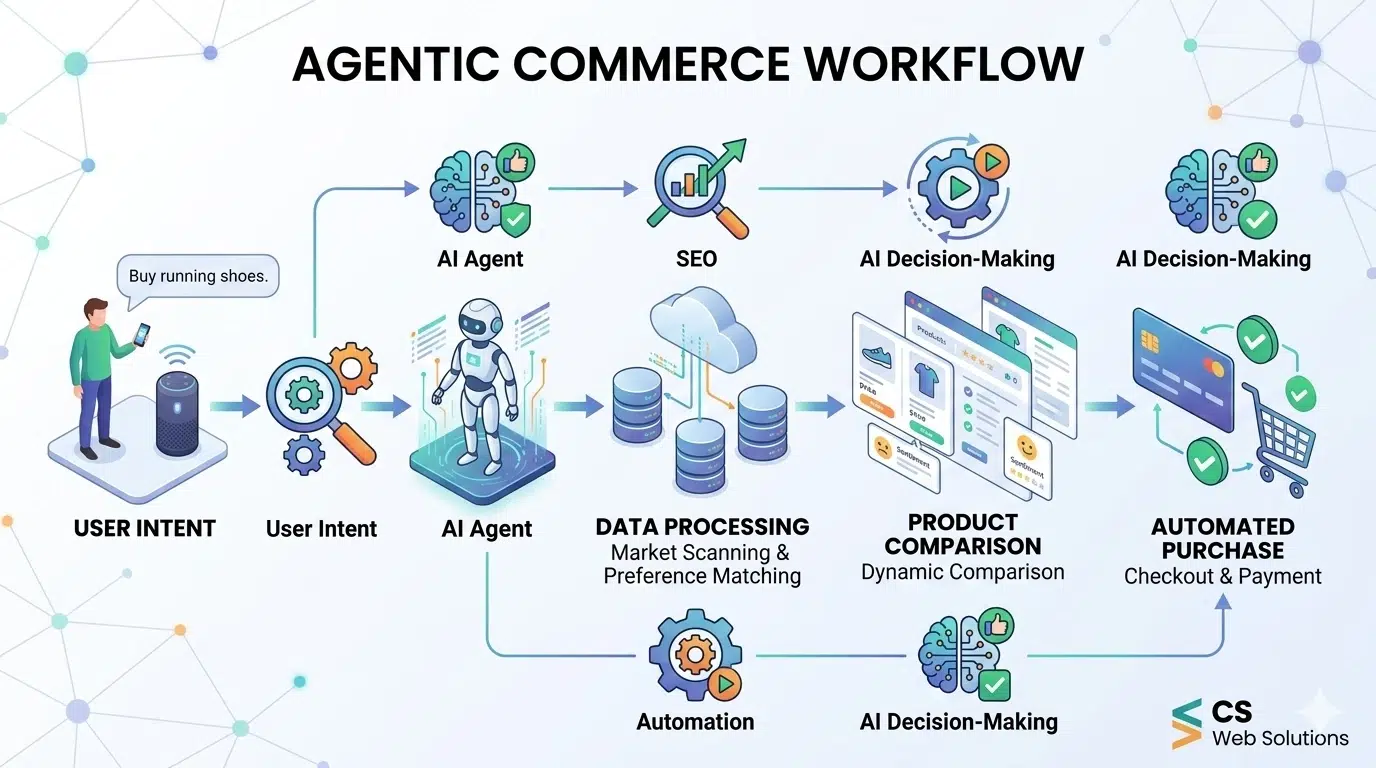
The process of AI agent workflow ecommerce starts when a user gives the agent a goal instead of a step-by-step command. That goal might be, “Buy the best office chair under my budget,” or “Reorder our best-selling product before inventory runs out.”
The API commerce agents then interpret intent. It looks beyond keywords and maps the request against preferences such as budget, delivery speed, specifications, brand limits, return policies, and past behaviour. This creates a decision framework rather than a simple search query.
At the same time, the agent uses an autonomous transaction process to check multiple websites, marketplaces, and platforms side by side, gathering data from a range of sources to quickly surface the best options.
After comparison, the agent acts. It can place the order, reserve the item, trigger a subscription, submit payment, or route a shortlist back for approval, depending on permission levels.
The agent finally responds with a summary of what was selected and why. It will also enlist cost and explain the product checkout process. This end-to-end workflow differentiates agentic commerce from traditional e-commerce automation.
Agentic commerce in digital marketing represents a structural transformation in marketing logic, not merely the emergence of a new distribution channel. The underlying shift is consequential: marketing has historically been oriented toward human consumers characterized by non-linear browsing behaviour, emotional deliberation, and comparative hesitation. Agentic systems, by contrast, operate through intent resolution, relevance assessment, trust signal evaluation, and transactional clarity. To be an expert before marketing to AI agents, brands must focus on clarity and immediate relevance. With this transition, four key developments are driving the change. They are hyper-personalized decisioning, intelligent ad formats, automated journeys, and intent-driven SEO.
 Automated Customer Journeys
In a traditional funnel, brands fight for attention through ads, landing pages, forms, cart recovery, and nurture emails. In an AI agent customer journey, much of that friction disappears because the agent handles the path from discovery to purchase on the user’s behalf.
A frictionless e-commerce AI flow handles everything from the discovery of products to post-purchase steps. These systems anticipate needs and make recommendations. Upon your pick, it will manage follow-up steps automatically. This automated customer journey replaces fragmented touchpoints with a unified experience that feels intuitive and responsive at every step.
Traditional advertising speaks to the human tendency to be moved by beauty, story, or the unexpected. AI agents process without sentiment, filter without distraction, and respond only to what is a signal, never to what is merely noise.
Agent-targeted advertising is introduced as a new category of paid media. It is specifically designed for assisting in AI-driven decision-making. It has a spot-on structure, machine-readable formats that present product specifications, shipping timelines, return policies and much more. AI agent ad targeting offers functional value over branding. It draws on the data to make confident decisions on behalf of users.
The rise of AI agent SEO is quietly moving the discipline away from keyword alignment and toward intent inference. User behaviour at the cognitive level remains largely unchanged; people still navigate by broad, intuitive categories. What has changed is the layer that translates that intent into results. But agents do something different. They decode the underlying meaning of those queries, surfacing the real decision criteria: price sensitivity, timeline, product constraints, values such as sustainability, or technical compatibility. The search signal is still human. The interpretation is now machine.
That makes intent-based SEO far more practical than surface-level keyword targeting. Content has to answer the questions agents anticipate before the user even asks them directly. Search intent optimization will increasingly depend on structured data for AI, strong entity signals, verifiable claims, and pages that communicate facts without fluff.
Agentic commerce SEO impact will be most visible in implementation. Brands should prioritize featured-snippet formatting, FAQ schema, product schema, offer schema, review markup, and how-to schema so AI systems can extract answers cleanly.
SEO for AI agents is dedicated towards making content factual and easy to validate. As the lines between voice and agent search blur, schema markup will evolve into a core requirement for visibility. The future of search engine optimization will hinge on how smoothly content aligns with AI-led decision paths and automation.
The gap between old vs new digital marketing becomes clearest when you map out what each model actually does at every stage of a buyer interaction.
Dimension | Traditional Digital Marketing | Agentic Commerce |
Campaigns | Manual campaigns built and managed by teams | Automated decisions executed by AI agents in real time |
Targeting | Static targeting based on demographic segments and past behaviour | Dynamic targeting driven by live intent, preferences, and constraints |
Customer Journey | Funnel-based — ads → email → landing page → cart → abandonment recovery | Journey-based — agent moves from goal to transaction autonomously |
Content Format | Persuasive copy, visuals, and creative assets designed for human emotion | Structured, machine-readable data — price, specs, availability, policy |
Decision Driver | Human persuaded by messaging, brand familiarity, and creative appeal | The agent selects the best fit based on logic, fit criteria, and verified data |
Measurement | Clicks, impressions, open rates, and assisted conversions | Recommendation share, agent conversion rate, and autonomous resolution |
In traditional marketing, a human sees an ad, clicks through, lands on a page, and gets persuaded by a copy. In the AI marketing comparison, an agent reads structured data, compares options across platforms, and selects the best match, with no persuasion required at any step.
The fundamental shift in agentic commerce vs traditional marketing is that brands no longer compete for human attention; they compete for agent selection.
Businesses that adapt early can unlock several advantages:
One of the key agent-driven sales benefits is higher conversion rates driven by real-time optimization.
For all its upside, agentic commerce also brings a new set of decisions marketers cannot ignore. The biggest risks of AI marketing are not just technical problems; they affect brand control, customer trust, and how digital teams operate day to day.
These agentic commerce risks are solvable, but they require attention, governance, and thoughtful implementation from the start. Concerns around agent-led commerce, marketer readiness, and operational change are already being emphasized in current industry discussions
In the upcoming years, digital marketing will lean more on Agent capabilities. The agent-first marketing prioritizes structured data and system integration. Marketing teams will require to develop stronger capabilities aligned with AI literacy to understand how AI makes choices.
Measurement will change, too. New metrics are already emerging around recommendation share, assistant impressions, autonomous resolution, and other indicators that reflect marketing predictions in AI and complete decisions for a brand.
Marketing teams are about to look very different. In an Agentic AI future, expect a wave of new hires, structured-data specialists, automation architects, and API strategists as machine-readable commerce stops being a niche concern and starts being a core business function. Display ads aren’t going anywhere soon, but their golden era may be fading as more buying runs through AI agents and platforms build harder around that reality.
Agentic commerce is not a minor upgrade to e-commerce. It is a structural shift in how demand is discovered, evaluated, and converted.
Brands that make their offers clear, machine-readable, and agent-friendly will be easier to choose in the next era of buying. For companies investing in AI SEO/GEO, digital marketing, and future-ready digital infrastructure, CS Web Solutions already positions these capabilities as part of its service stack.